Thursday, March 06, 2014

Evaluating NoSQL databases - MongoDB

Introduction

MongoDB is undoubtedly one of the most popular document-oriented databases.  It brings to the table the powerful queryability of relational database and distributed nature of NoSQL databases like HBase or Cassandra.   We will see in this post that MongoDB provides a sophisticated set of unique features and you can decide how it meet your needs.

Key Features 
  • High Availability through replicated servers and automatic master failover
  • ACID compliance at single document level including nested documents
  • Scalability is achieved through automatic sharding 
  • Provides a distributed filesystem known as GridFS and can be accessed from the command line
  • Built-in functions and UDFs are written using JavaScript
  • Provides in built support for Map/Reduce/Finalize
Administration
  • Provides an admin shell for administrative tasks
  • There is an UI for Administration through MongoDB Management Service (Third Party Service)
Migration
  • Migration of a system (application) from RDBMS to MongoDB requires complete redesign and refactoring of code not just switching of drivers.   Please see the Drivers section for supported integration interfaces.
Time-to-market
  • With a straightforward installation and administration model it has a very fast time-to-market.  It is better than HBase
Drivers
  • Drivers are available for Java,  C, C++, Erlang, C#, Perl, Scala, Ruby, Phython, PHP
Community Support
  • MongoDB's huge installation base is expanding very rapidly.
  • Sources of support are listed here
Cost
  • Since HBase is opens-source practically you don't have to spend anything for the product.   But there is talent and infrastructural costs
  • Runs on commodity hardware so the cost is reasonable
  • Vendors offer professional support which varies based on your needs
Prominent Users
  • SAP, MetLife, eBay, MTV,  SourceForge and many others use MongoDB in their production environments
Security
  • Control access to MongoDB instances using authentication and authorization
  • Controls access to sharded clusters with key files
Supported Operation Systems
  • Windows, Linux, Mac OS X, Solaris
Resources
Conclusion

MongoDB is widely adopted NoSQL database which can be used from mid-to-huge data volume requirements unlike HBase and other databases which are suited for huge volume of data.  It provides a familiar programming paradigm with JavaScript and provides Drivers for popular languages which makes it a convenient choice.

Saturday, March 01, 2014

Evaluating NoSQL Databases - Apache HBase

Introduction

There is no doubt that there is a growing trend of adoption of NoSQL databases from startups to large enterprises.  There is also array of database choices in the market and the purpose of this series of posts is to assist you in evaluating various NoSQL databases.  In this post we will look at Apache HBase, the column-oriented database.  Here we will explore various criteria with a goal of helping you make an informed decision.  HBase is open-source Apache top-level project since May 2010 and is part of Apache Hadoop ecosystem.  It touts itself as a fault tolerant and consistent database and is based upon Google's BigTable.

Key Features 
  • ACID compliant database that can run transactional applications
  • Each row may have one column to millions of columns and billions of rows.  It is recommended to use HBase for huge volume of data.
  • HBase supports two types of compression algorithms: Gzip (GZ) and Lempel-Ziv-Oberhumer (LZO).  LZO is highly recommended over Gzip but due to licensing issues LZO doesn't come packaged with HBase
  • Bloom Filter is a really cool data structure supported by HBase which answers the question: "Is this data present before?".
  • Out of the box versioning support, a unique feature which makes HBase stand out
  • Supports High availability through automatic failover
  • Architecture facilitates scaling out quite nicely so hardware can just be added on an on-demand basis
Administration
  • Thanks to tools from vendors like Cloudera, Hortonworks administration has become easier over the years and is improving. 
  • In order to achieve fault tolerance, data replication can be configured within data center or between data center racks.
Migration
  • Migration of a system (application) from RDBMS to HBase requires complete redesign and refactoring of code not just switching of JDBC drivers.   Please see the APIs section for supported integration interfaces.
Time-to-market
  • Availability of tested HBase packages from commercial vendors has enabled faster time-to-market
  • Thanks to Hortonworks, HBase is now packaged for Windows so its easier for .NET shops to ship to market faster
APIs
  • APIs are available for Java, Thrift and REST protocols.  Support is also available for Avro.
  • Spring-Hadoop integration supports HBase
Community Support
  • HBase has a fast growing community of companies.  Hadoop vendors are also investing heavily on HBase development as they see the adoption rate growing in the enterprise.
  • Sources of support are IRC channel: irc://irc.freenode.net/#hbase and mailing lists
Learning Curve
  • As we have seen before there is support for a variety of APIs in popular platforms and this must shorten the learning curve.
  • Since HBase is part of Hadoop ecosystem the talent pool is increasing quite rapidly.
  • Simple syntax for developers to learn and remember
Cost
  • Since HBase is opens-source practically you don't have to spend anything for the product.   But there is talent and infrastructural costs
  • Runs on commodity hardware so the cost is reasonable
  • Vendors offer professional support which varies based on your needs
Prominent Users
  • Facebook, Meetup, eBay, Ning, StumbleUpon and Yahoo! use HBase in their production environments
Product Roadmap
  • Ability to take snapshots/backups and restore them at later point of time in an on-demand basis
  • Monitoring and diagnostics tools
  • Improvement to reliability and high-availability
  • Cell-level security
Resources
Conclusion
As they say one size doesn't fit all and hopefully this post addresses the questions/concerns you have in your mind.  We have seen that we can use HBase where there is huge volume of data with columnar requirements.   Those are obviously not the only criteria but we may need consider other factors listed above while making the selection.

Saturday, January 24, 2009

APIs in Action

There are a number of APIs released by various services everyday. I always "want" to play around with them and understand the possibilities that they provide but most of the time not do so.

Thursday, January 01, 2009

MyEclipse HQL

Though it has been few versions since MyEclipse had support for Hibernate and HQL, I only had a chance to play with it recently. It has a nice feature set and the HQL editor is tied Dynamic Query Translator which gives on-the-fly translation for HQL queries. This provides for an easy way to debug queries and validate them.

twitterclone

In order to open a HQL editor you need to create a file with .hql extension and also have an active hibernate configuration file. This took me a while to figure out. In order create an active Hibernate Configuration use File -> New -> Hibernate Configuration File and setup the connection parameters for the database.

Sunday, November 30, 2008

Enterprise Social Networks

There is no doubt that with the growing trend in the usage of Social Networks in the consumer space strongly suggests that they are here to stay. The benefits of the networks as an enabler of online social interactions can be derived to add social intelligence in enterprise context. Such networks will also facilitate the transformation of organizational structure from traditional hierarchies into networked hierarchies. In this post I will walk through some of the technology options that are available out there for building Enterprise Social Portals/Networks:

Apache Shindig:

Apache Shindig is a Reference Implementation for OpenSocial specification. With this you can expose your existing Social Graph and it acts as a container for OpenSocial widgets.

SocialSite:

SocialSite is an open source initiative from Sun Microsystems providing a complete end-to-end user interface and an API for social networking. It supports widgets by providing an OpenSocial container by leveraging Apache Shindig in its architecture.

RingSide Networks:

RingSide Networks is an open source offering that enables any website with social networking capabilities by providing implementation for both Facebook and OpenSocial specifications. RingSide acts as a powerful container hosting social information and as a bridge to Facebook social information platform hence providing interoperability. The only issue with this is its still in Beta.

Liferay:

Liferay is also an open source offering which provides both enterprise portal and social collaboration platform software. The solutions provide components for Web 2.0 features like Blogs, Wiki, Calendar, etc. It also provides a way to host social graph and promises OpenSocial Apache Shindig integration.

Saturday, July 05, 2008

Signing up Users

I'm planning to write a series of posts under "Tech Tip". The purpose of these posts are to share ideas/tips around how companies can leverage technology approaches in their solutions to gain competitive advantage. I also intend to provide technology implementation details as applicable.

One of the major goals for a startup is to motivate users to sign up for their service and eventually to sustain the user base. There are a bunch of startups coming up everyday and from an user its quite overwhelming for them to remember credentials for all of them. As Joshua Porter puts it in his Usage Lifecycle, the challenge here is to Sign-up an unaware/interested user. Even early adopters who might be interested in trying your service may not be motivated. But we can solve this problem by leveraging authentication technology possibilities.

It is very likely that your interested user will have one of Hotmail/Yahoo/Facebook/Google/OpenID account.

By providing your users to authenticate using these services will definitely increase the probability of an enthusiastic user to sign up. These services have libraries and documentation in their respective developer web site.

Clickpass

Clickpass is a startup providing single sign-on service that requires no effort from the end-user but provides the convenience for your site to authenticate using Google, Facebook, Hotmail and Yahoo accounts. They provide extensive developer documentation and can be found here. TechCrunch also has coverage about this service. However there are also views like these that you need to be aware of before making your decision.

OAuth

OAuth is an open initiative for an open protocol to allow secure third-party website authentication . Its starting to gain traction and worth keeping an eye on their blog.

Resources

Live ID Web Authentication System
Yahoo BBauth
Google Account Authentication API

Sunday, June 22, 2008

Evaluating AJAX Framework

Today building a new web application involves the essential step of evaluating AJAX frameworks and select an appropriate one. In this post I will detail the various criteria that should be considered while making a decision.

Adoption Criteria

This criteria is important for IT managers (or EA strategy) to decide if it would even be necessary for the development team to take a look and evaluate.
  • Licensing Model: Under what license(s) is this product offered? How would that affect your organization?
  • Cost: How much does the framework cost (upfront)? Also consider cost of development tools, support, consulting? How many free updates are there? If the framework is free, is there a PRO version? If so what are the benefits and cost?
  • Frequency of Releases: What is the frequency of releases/updates? Is it adequate? This shows how active the framework is among the community?
  • Technology Maturity: How long has the framework been around? How stable are the releases? What is the philosophy on backward computability? What is the product road map?
  • Talent Pool: Is there talent pool available for this framework? What is the expected learning curve? Input from the developmental team is certainly helpful here.
Development Criteria

This criteria is will help the developers assess the framework viability.
  • UI Components: Does the toolkit offer rich set of mature components? What is the future road map for new components? Are the components customizable?
  • Programming Model: What kind of programming paradigm is supported? Is it strongly typed or dynamic? Is the model familiar to developers? If not what is the learning curve?
  • Web Framework Integration: Are there web frameworks that provide some out-of-the-box support? Are there any conflicts (or challenges) in using this toolkit with web framework?
  • Documentation Quality: Is there adequate good documentation available? Are there books available? If so what are the reviews?
  • Browser Support: What browsers and versions are supported by the toolkit? What is the road map? Are the supported browsers sufficient for the requirements? What does the community say about this?
  • IDE Support: Is there IDE support? How much do they cost? How do they fit in with currently used IDE?
  • i18n: Is there support for multiple languages?
  • Utilities: Frameworks provide utilities like Browser Manager(Back/Forward Button Support), Drag-n-Drop, Java-to-JavaScript Serialization (for example, DWR). Depending on specifics of the requirements this criteria should be considered.
Maintenance Criteria

This criteria helps to evaluate and foresee any maintenance challenges that may be encountered.
  • Community Support: What is the size of the community using the product? How active and responsive are the online forums? Is the blog updated frequently?
  • Hosting: Is there hosting support for the framework JS files? For example, Yahoo UI provides hosting support
  • Profiling: Is there built-in profiling support? If no are there any external tools that can help? Are there browser related constraints in them?
  • Beta Components: The frameworks tend to offer lot of Beta components. For these components its worthy to look at their known issues and assess the risk.
Conclusion

Analyzing and evaluating the frameworks using the above mentioned criteria will help make an informed decision and thereby will help avoid potential future issues. During the evaluation if a framework is missing a particular feature or component and is available in another toolkit you should look to ensure that there would be no integration issues and will peacefully co-exist. Please feel free to suggest perspective for improving the evaluation process.

Sunday, May 04, 2008

Jaxer - An innovative paradigm

Jaxer is an open-source web application development framework providing an consistent Javascript based programming model between the cloud (server) and client. In this post I will provide an architectural overview of this technology and provide a conceptual mobile strategy that this framework can be used for.

Architectural Overview

The core of Jaxer is written in C/C++ and is powered by the same Mozilla engine that powers Firefox 3. There is a wrapper Javascript framework which can be easily extended by developers if needed.

Jaxer provides a plugin as post-processor to the web server and receives an static HTML as input. The core framework is responsible for parsing the input, executing scripts (server-side) and generating proxies.

The framework allows the developer to mark Javascript functions to be executed in the server using - runat="server" attribute in the script tag. There is also runat="server-proxy" where when the client calls are redirected to be executed in the server, the framework is responsible for injecting the methods.

From the server-side code there is also access to the Jaxer library and hence access to session, file system, database, network sockets, etc.

Thanks to Aptana for the image.

Mobile in Minutes

Here I would like to outline an use-case which will enable web properties to quickly create a mobile flavored output using Jaxer. This is intended to be a proof-of-concept and an example for the possibilities enabled by this framework. Lets say you have an existing simple web application and want to enable mobile flavored version modifying the existing application. This solution levereges the server-side processing of Jaxer to identify elements of interest from the HTML and renders a modified output.

Here the idea is to annotate on the HTML elements of the original output. It could be id="mobile-????". This step is just to identify elements of interest and construct a modified html. Here is a brief code snippet which should provide some direction and simply by injecting this script and marking ids mobile should do the job. This is no way intended to be a full-fledged implementation but to give a direction and server as a proof-of-concept:


var k = document.getElementById("b");
var m = document.createElement("body");
var e = document.getElementsByTagName("a");
m.innerHTML = 'Mobile rendering: ';
for ( var i = 0 ; i < style="font-style: italic;">
{

var l = e[i];
if (l.id == 'mobile') {
m.innerHTML = m.innerHTML + ' ' + l + ' +'';
}
}

k.innerHTML = m.innerHTML;

Infrastructural Support

Jaxer can "peacefully" co-exists with your open source technology stack. Jaxer can work with your existing Apache installation and have IIS support in their roadmap. Presently MySQL database is supported but definitely this is an area for improvement. There is also support Tomcat based deployment model and out-of-box support for running in EC2.

Conclusion

Emerging programming models such as Jaxer provide possibilities for more innovative web application extensions. This form of web extensions is extremely useful in enterprise and consumer environments to try-out in a plugin in on-demand.

Technorati Tags: ,

Friday, April 25, 2008

AB Meta: Whats is this thing? but what is that?

AdaptiveBlue announced AB Meta specification in an effort for web pages to expose data about "things" in a standardized way. In this post I will briefly outline in simple terms what this means and propose some conceptual extensions that could provide possibilities for more use-cases.

The purpose of AB Meta specification is to enable web pages (that talk about "thing") to expose their attributes in a standardized way so that programs can understand. For example consider this page from amazon.com: Click Here. It is the landing page for the book titled "Programming Collective Intelligence". Taking a closer look at the source of the page today the following META tags can be found:

<meta name="description" content="Amazon.com: Programming Collective Intelligence:
Building Smart Web 2.0 Applications: Toby Segaran : Books"
/>
<meta name="keywords" content="Toby Segaran ,Programming Collective Intelligence:
Building Smart Web 2.0 Applications,O'Reilly Media, Inc.,
0596529325,Computer Programming,Machine Learning,Computers,Computers -
General Information,Computers - Languages / Programming,Computer Books:
Languages,Artificial Intelligence - General,Programming - General,Computers / Artificial Intelligence,
Computers / Languages / Programming,Computers / Programming / General,Computers/Artificial Intelligence -
General,Data processing,Economic aspects,Information technology,Knowledge management,
Social aspects,Programming - Algorithms,Programming Languages - Python,Internet programming,Web site development"
/>
As you can see the META tag provides metadata about the book in a unstructured way, so for instance bn.com might provide in a different format (or not at all). This is the problem that AB Meta is solves.

AB Meta proposes to leverage META tag and use a standardized format to describe a "thing". A "thing" could be a book, music, cycle, car, movie, etc. This post from their blog provides a good introduction with examples. In a AB Meta enabled amazon.com the meta tags could look like this:

meta name="'object.type'" content="'book'"
meta name="'book.name'" content="Programming Collective Intelligence"
meta name="'book.author'" content="Toby Segaran"
meta name="'book.isbn'" content="0596529325"

etc..

Extensions

Here are few extensions (new attributes) which I believe would worth considering:

OBJECT_TYPE.unique_attr:

The purpose of this attribute is to specify which of the listed attributes universally identify this object uniquely. For books it could be book.isbn and so

book.unique_attr='book.isbn'

Given the growing trend for open data I believe this extension will open up lot of new possibilities.

OBJECT_TYPE.context_attr:

Pages could use this attribute to optionally specify under which context they are talking about the object. For example a user search based on author_name could return a list of books in this case the context is author.

book.context_attr='book.author'

OBJECT_TYPE.ATTRIBUTE_uri:

This is an optional tag that pages can use to publish an URI that talks more about the value of a given attribute. For example for the author of a book it could refer to his wiki page, home page, etc. :

book.author_uri='http://kiwitobes.com/'

Though this might not be very frequently used it is useful tool to present contextual data.

So this answers, what is that?

Conclusion

There is no doubt that the initiative will definitely provide a standardized way for the publishers to expose meaningful contextual data. However the ultimate success of the initiative lies in the adoption by the community. Here the community primarily being online product vendors and services.
I certainly as always welcome any thoughts/comments on the attributes on their implementation.

Sunday, December 16, 2007

Gearing up for Privacy

The issue of Privacy is one of the major concerns in the web today. The most common of such concerns centered around the user data having to live in the cloud with the potential for it to be exposed, stolen or misused by external elements (including the service provider). In this post I share my thoughts on how some of the emerging technologies can help address some of the concerns.

Emerging technologies such as Google Gears, Microsoft Sync Framework and Microsoft Volta provide programming paradigms around online/offline synchronization and an execution context. As you may already know Google Gears opens the possibility of the synchronizing content with browser plugin to provide seamless offline experience of online content. For example services like Google Reader and Zoho Writer leverage this today in their offerings. Microsoft Sync Framework opens the possibility of data synchronization across any device and data format. While Microsoft Volta promises to decoratively allow developers to execute content both online and offline.

As stated earlier the concern of the user data having to live in the cloud can be eliminated by architecting applications to load data locally. The web essentially becoming a platform for software delivery while data may be securely stored locally. The user has the choice of storing data in a medium of his choice, for example in USB drive or local hard-drive or just online. Technology support for encryption capabilities to securely store content should be just a matter of time.

Also the service providers wanting to provide data-sensitive contextual user services/experience may leverage paradigms provided by Volta. This will ensure that any user concerns around Privacy are addressed as well.

As the concept of web as a platform continues to grow so will the user's concern of Privacy and data security. Emergence of technologies and their application in creative ways may help address such inevitable concerns.

UPDATE:

Related:
Google Gears Enabled Sites

Saturday, September 08, 2007

Auto-translate Resource Bundles using Google Translate

Internationalization is one of the common requirements in web applications. One of the challenges faced by a team is the non-availability of translated resource bundles during development (mostly due to logistical reasons). But it is important to test various scenarios during the application development.

In this post I will present a simple idea which utilizes Google Translate to auto-generate translated Java Resource Bundles for the language of choice. Just send a HTTP GET request with the text to be translated to Google Translate URL and read the translated text by parsing the response. In order to translate an entire resource bundle just pass a source bundle (For example, English) and read each property and write to target language resource bundle file.

Here is the URL for translating "welcome" from English to Spanish http://www.google.com/translate_t?langpair=en|es&text=welcome

Here is a snippet of Java code which utilizes Apache Commons HttpClient library :

String url = "http://www.google.com/translate_t? langpair=en|es&text=";
String text = "welcome";

HttpClient client = new HttpClient();
GetMethod getMethod = new GetMethod(url + text);

client.executeMethod(getMethod);
String xml = getMethod.getResponseBodyAsString();
xml = xml.substring(xml.lastIndexOf("<div id=result_box dir=ltr>"));
String translated_text = xml.substring(27, xml.indexOf("</div>"));
System.out.println(translated_text);

Technorati tags: , , ,

Monday, August 27, 2007

mylivesearch.com -- trawl the web

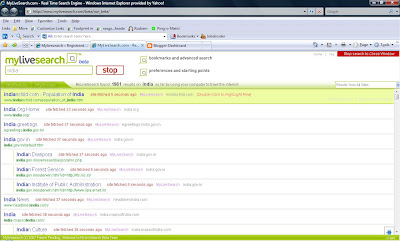
I received the much awaited mylivesearch.com beta release invite few minutes before.

Here is a screen shot

The real-time search is obviously slower than the Google search and also not ranked. Filtering by website feature is pretty helpful.

UPDATE: I just observed everytime you search for something mylivesearch hits the website explicitly. I confirmed this using my web analytics (StatCounter -- used for this blog) to test.

Sunday, August 19, 2007

Google Reader Helper for Firefox

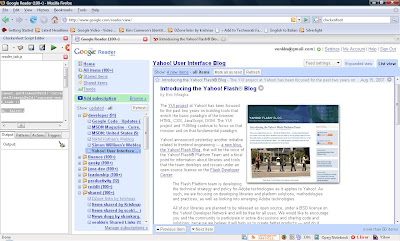
Google Reader is one of the most popular web services and I personally use it everyday. One of the features that I miss using a RSS reader is the ability to view comments. In this post I would share a simple hack to help with this issue and to more importantly serve as a proof-of-concept for possibilities around web application extensions. It is written on a framework called Chickenfoot for Firefox that I recently stumbled upon.

What is Chickenfoot?

Chickenfoot for Firefox is itself a Firefox extension that puts programming environment in the browser's sidebar that allows you to write scripts to manipulate the web pages. Chickenfoot is a superset of JavaScript and puts the user in control of writing quick extensions to web pages. There is a detailed quick start tutorial of Chickenfoot here and the extension can be installed from here.

Google Reader Hack

While reading a post in Google Reader there will be only one expanded view of the post which lives under the <div> with id='current-entry'. This hack leverages this to identify the post that user is currently reading and loads that page in another tab automatically. If you're interested in quickly checking/leaving a comment for the post, then you can switch to the other tab and do so immediately without having to click and wait for it to load.

Once you have installed Chickenfoot, download the script here and open Google Reader on Firefox and start the script. If you're familiar with JavaScript then it should be self-explanatory.

Conclusion

Chickenfoot programming paradigm could be used to enhance web experience for user's convenience. Also the intersection of Chickenfoot with concepts like Programming Collective Intelligence will fuel greater innovation by allowing user to be more in control of the experience.

Resources

Chickenfoot For Firefox

Chickenfoot Blog

Google Reader Helper Script

Technorati tags: , ,

Sunday, August 12, 2007

Caching: Memcached and Terracotta

Applications are generally built with an expected user base but soon might be overwhelmed due to business demand. This is especially particularly true in the context of consumer facing applications. Caching is one of the most important aspect to improve application performance by storing object in Cache (memory) reducing database load.

Caching in a clustered environment requires a Distributed Caching solution which can support failover scenarios and data reliability. In this post I would like to explore the capabilities of Memcached and Terracotta as distributed caching solutions.

Memcached is a high-performance distributed object caching system with client APIs for Perl, PHP, Python, Ruby and Java. Here are some of its capabilities and limitations (using Java client API):

  • Requires objects to be Serializable
  • Object Identity is NOT preserved
  • Supports cache expiration
  • Does NOT handle failover scenarios
  • For a given object selects a server from a pool of cache server based on hash of the key
  • Easy to configure (through SockIOPool class)

Terracotta is an open-source Java based clustering solution for JVM. Distributed Caching can be achieved using Terracotta by using a java.util.HashMap or open-source caching solutions like EHCache, OSCache and JBoss TreeCache.

  • Preserves Object identity
  • Manages memory efficiently through Virtual Heap
  • Declarative requirement for lock support
  • Simple configuration file with Eclipse Tool support
  • Good documentation, support and active development
  • Due to the nature of its implementation certain classes are not Portable and hence cannot be used
  • Hard to determine which third-party classes are portable
  • Does NOT require classes to be serializable
  • Easy to configure and get started!
Technorati tags: ,

Thursday, August 09, 2007

Data Services in Spring

In today's web applications the need for returning model data from controllers in XML/JSON format is quite common. Mostly these requirements are met by writing custom code in controllers. In this post I will present technical approach that would enable your applications to return data model in XML/JSON or data format of your choice to the web tier using Spring MVC without modifying your applications.

Basically the idea is to return XML(or JSON, etc) whenever we encounter a request to the controller with parameter returnData=XML. This can be accomplished by writing a HandlerInterceptorAdapter with postHandle method to do the following:

void postHandle(HttpServletRequest request, HttpServletResponse response, Object handler, ModelAndView modelAndView)
{

if ( request.getParamter("returnData") != null && request.getParamter("returnData")="XML" )
{

// add a XML Serializer to the model
// Find the model object names and add the list to model attribute "xmlModules"
// Set the view name to "xmlView"

}

}


In your xmlView (JSP or Velocity Template) for each attribute in xmlModules use the XML Serializer to generate XML and render it. There are few applications for this approach:

1. Enable front-end to readily use AJAX for existing controllers
2. Use this as a strategy to get a debug view of model data during development
3. Based on some additional key use this to get debug view from production for troubleshooting purpose

Resources:

1. XStream for XML Serialization

Tags: java spring ajax

Wednesday, August 08, 2007

Kudos for AOL local

I stumbled upon a feature on AOL Local Search which I felt is really innovative. Lets say you search for "pizza" near a particular address and then you drag the map, it automatically searches and plots businesses relevant to the search in the current focus of the map.

Saturday, June 30, 2007

iPhone innovations

Now that iPhone is finally released and is now time to watch for new iPhone apps.

Morfik , Backbase and Aptana have released AJAX based development tool (platform) for building iPhone applications. There is also an impressive list of iPhone applications here

Tags: technology apple iphone

Friday, June 22, 2007

Click-n-Save Web Page as PDF

I stumbled upon a service called Save as PDF from PDF Online. Here is a browser button hack which allows you to convert the current web page. Just drag-n-drop this link into your web browser:

Monday, June 11, 2007

Safari - Windows ready!

Apple today released Safari for Windows!   The beta version of the  fastest browser is now available for download.

My favorite feature is the privacy friendly single-click Private Browsing.   I checked out the developer resources to find resources for plugin development in Windows environment but unable to find as yet :(

Friday, June 01, 2007

Instant Translation

I stumbled upon Google Translation Browser Buttons:

http://www.google.com/translate_buttons?hl=en

Just drag your frequently used translation requirement buttons into your browser bookmarks bar!

Disqus for techtalk